Historical Society Celebrates America’s 250th Anniversary
Historical Society Celebrates America’s 250th Anniversary
By Cathy Chance Harvey
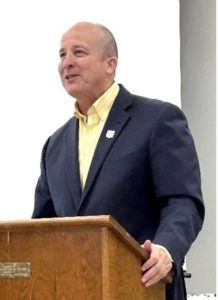
On February 26, 2026, the Walthall County Historical Society (WCHS) celebrated the 250th Anniversary of America’s independence with a luncheon meeting featuring W. Brother Rogers, a distinguished Mississippi public servant, educator, and historian who retired in 2025 as Director of the Programs and Communication Division of the Mississippi Department of Archives and History (MDAH). He is known for his work in public policy, particularly with the John C. Stennis Center for Public Service and for fostering improved race relations. Brother Rogers gave a fascinating talk on the life of General Lafayette, including his role in the Revolutionary War and his visit to Natchez in 1825 during his farewell tour of the U.S.
In acknowledging February as Black History Month, the meeting was dedicated to professional sprinter Jordan Anthony, 2022 graduate of Tylertown High School and winner of the 2025 Bowerman Award. Tables were decorated with tributes to Jordan in the form of track-and-field centerpieces, including a blue-and-gold track shoe stamped “Sippi Fast.” Decorative picks inserted in a floral arrangement were labeled “#6,” Jordan’s high school football jersey number, and “6.43s,” his personal best time when he won the 60-meter dash at the Tyson Invitational in Fayetteville, AR, on February 13. Since the Historical Society meeting, Jordan has set an even higher standard: He competed in the World Athletics Indoor Championships in Torun, Poland, on March 20, and won the title of fastest runner in the world when he finished the 60m race in 6.41s. That’s fast. Sippi Fast.
Also among dining table centerpieces were small, rustic vases containing criss-crossed American and French flags from the period of the Revolution embedded in red, white, and blue flower buds, symbolizing the Franco-American alliance. The French theme was extended to the buffet, provided by Magnolia House: croissants stuffed with their signature chicken salad. John Shilling brought his popular white chocolate bread pudding, a French-influenced Louisiana Creole dessert.
In the business portion of the meeting, President Cathy C. Harvey announced that at the January 5 meeting of the Walthall County Board of Supervisors, she had requested on behalf of the WCHS that the Board submit a suggestion to the Mississippi legislature to issue a resolution honoring Jordan Anthony; a motion ensued and was passed by a unanimous vote. In regard to the upcoming annual meeting of the Mississippi Historical Society (MHS) on March 5-6, Dr. Harvey announced that the WCHS had purchased a corporate membership in order that members could attend at a discounted registration rate and be present when the WCHS would receive the award for Outstanding Local Historical Society in Mississippi. Finally, the Society voted unanimously to partner with Church on Beulah, the former Tylertown United Methodist Church, to secure a MDAH state historical marker for the historic Methodist church, which dates to 1917.
Business concluded, Dr. Harvey welcomed Brother Rogers to the podium, who dove into his riveting Power Point presentation on General Lafayette. He began by noting how many places in the U.S. are named after the war hero: Lafayette Park, directly north of the White House, Lafayette Square in New Orleans, Lafayette County in Mississippi, for example, and more than 30 cities and towns. Only two pictures hang from the walls of the U.S. House of Representatives Chamber: a full-length portrait of Lafayette to the left of the Speaker’s rostrum, and a similar portrait of George Washington to the right, representing their close bond. Lafayette was the first foreign dignitary to address the House of Representatives, and the portrait commemorates his Revolutionary War service.
Lafayette’s service began at the tender age of 19 when, as an immensely wealthy member of the French nobility, he became intrigued with the American Revolution and with George Washington. Thwarting Louis XVI’s desire that France not get involved, Lafayette secretly bought a ship and outfitted it with sailors and ammunition and set sail for America on April 26, 1777. Two months later, he arrived off the coast of South Carolina near Georgetown. He and his party, including Baron de Kalb, traveled overland for three days to reach the capital city of Charleston. Lafayette struggled to convince the authorities that he was truly a rich marquis and there to help. Upon arriving in Philadelphia, then capital of the U.S., Lafayette met General Washington, who welcomed him into his “family.” It was the beginning of a deeply close personal relationship.
Lafayette demanded that he be named a general in the Continental Army, work for no pay, and report directly to General Washington. These conditions were met, and the young Frenchman soon distinguished himself at the Battle of Brandywine on September 11, 1777, when he organized the Army’s orderly retreat, despite being wounded in the leg. After spending the winter of 1777-1778 with Washington at Valley Forge, Lafayette returned to France where he encouraged support for the American cause. By 1780, he was back with the Army, commanding one of the three American divisions in the Siege of Yorktown in 1781. He witnessed the surrender of Lord Cornwallis, aided by the French Fleet and the French Army.
By 1824, Lafayette was the last living major general of the American Revolution. President James Monroe invited him to return to America, and, according to Brother Rogers, his visit was “one of the greatest celebrations in American history.” The bond between the president and Lafayette had been cemented when Monroe was instrumental in securing the release of Lafayette’s wife, Adrienne, imprisoned in Paris during the Reign of Terror and scheduled for the guillotine.
During his farewell tour, Lafayette visited all 24 states, including Mississippi. Enroute from New Orleans to St. Louis on the Mississippi River steamboat Natchez, he stopped off at the town of Natchez, where the war hero was honored with a 24-hour
celebration, including cannon firings upon his arrival, a procession up the bluff, a reception at the Steamboat Hotel, a formal address, and a ball at Travellers Hall. Lafayette’s personal secretary, Auguste Levasseur, later wrote that upon leaving Natchez, “We parted from the civilized world.”
One artifact remains from Lafayette’s visit to Natchez, Brother Rogers said in closing. He had brought a gift, a walking cane, to Governor Walter Leake (1762-1825), third governor of Mississippi and a fellow veteran of the Revolution. Governor Leake was not present, as he was in Jackson, gravely ill. He died later that year. The silver-tipped cane stayed in Governor Leake’s family. In 1910, Leake’s great-granddaughter donated it to the Mississippi Department of Archives and History. It is now on display at the Museum of Mississippi History in Jackson.
Following his talk, Brother Rogers graciously distributed to the audience complimentary copies of the Fall/Winter 2025 issue of The Journal of Mississippi History, which includes his article, “Lafayette Visits Mississippi as the ‘Guest of the Nation.’”
Prior to adjourning the meeting, Dr. Harvey presented Brother Rogers with a token of appreciation from the WCHS, a vintage powder-blue vintage Wedgewood trinket tray featuring a cameo bust of Lafayette and his signature.
Please join us for the next Historical Society luncheon meeting, April 26, from 11:00 a.m. to 12:00 noon, in the Walthall County Public Library to hear journalist and historian Doug Walker talk about historic buildings and former railroads in Tylertown. Everyone is welcome. Please follow us on Facebook and address inquiries to [email protected] or text 228-223-3984.